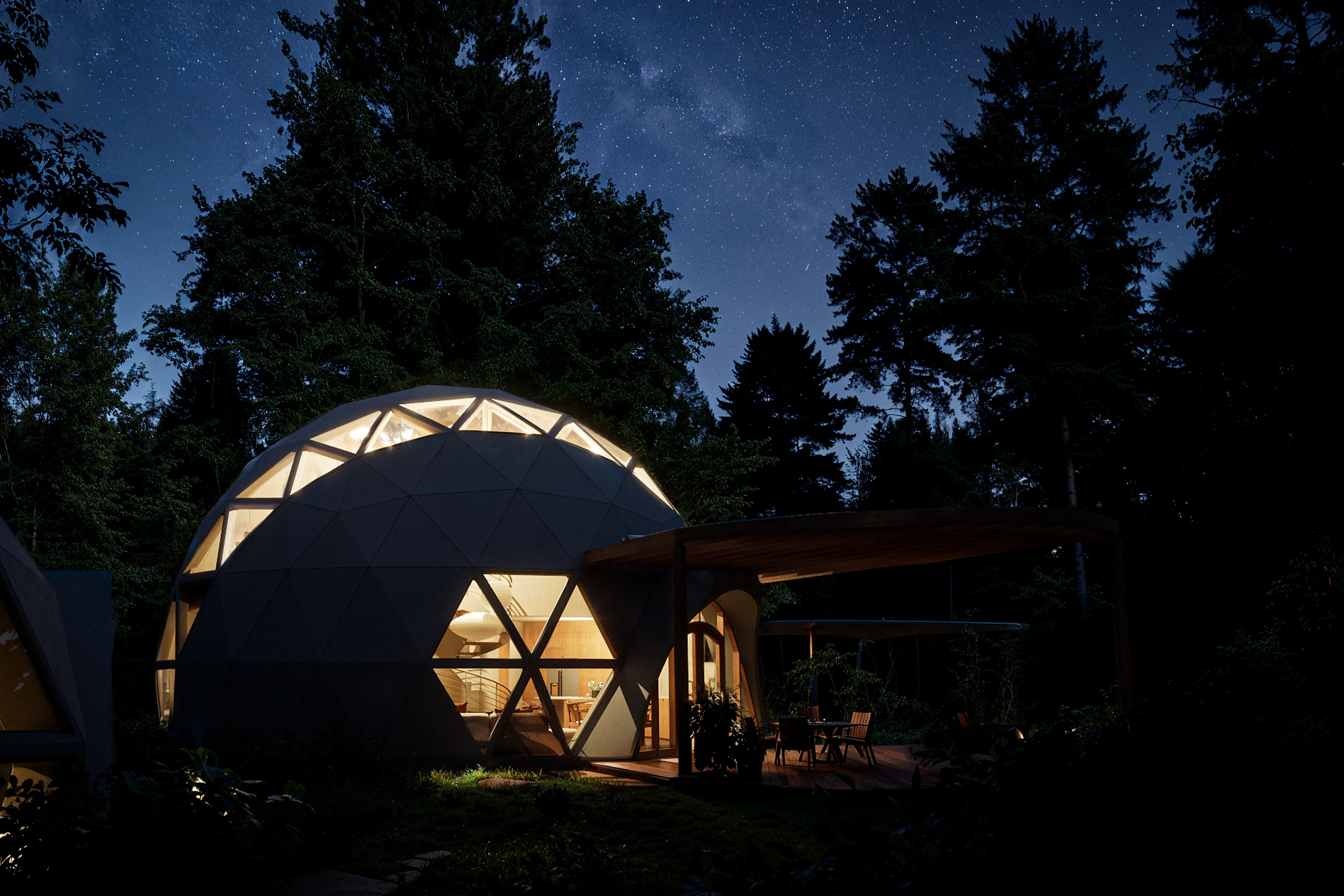
Welcome back to GeoJourney Episode 9. Last episode, you watched exterior bioceramic panels and windows being lifted into place. Now, the entire exterior shell of Amma One is complete, and the build is moving inside.
This episode takes you through the final stages of enclosing the dome, then follows the team as they begin transforming the interior with loft floor installation. And for the first time, the cameras head off-site and into the Geoship Pilot Factory, where Andrew James, VP of Engineering, gives a personal tour of where every dome component is born.
What You'll See in this Episode:
The Complete Exterior Shell and Interior Loft Floor: With all skins bonded, all 47 windows installed (including three operable egress windows), and door housings in place, the exterior of Amma One is fully enclosed. Inside, the team has moved to Stage 2: installing the loft floor that will divide the dome into two stories. You'll see the center ring, joists, purlins, and MGO subfloor panels come together in a system designed for plug-and-play assembly.
A Tour of the Pilot Factory: Andrew James walks you through the full production line, from raw material intake to mixing, curing, demolding, quality control, subassembly, and crating. This is where Geoship is developing the core manufacturing technology that will scale well beyond Amma One.
Completing the Shell: From Structure to Enclosure
When Episode 8 wrapped, three rows of exterior skins were in place and seven windows had been installed. Since then, Neil Decker and the install team have finished the job. Every bioceramic panel has been bonded to the frame. All 47 windows are locked in.
The final pieces of the exterior envelope were the door housings, hubs and struts that frame two entryways on opposite sides of the dome. One will hold a double French door. The other will feature a single door flanked by glass panels on either side, with bioceramic panels above and beside to match the rest of the structure.
Three of the windows are operable egress units, designed and built in-house at the Geoship factory. Each one features a dual-lever mechanism: one mode opens the window approximately six inches for ventilation, while a second mode swings it wide enough to serve as an emergency exit.
With the skins and windows in place, the team completed the exterior by applying BondRock, the flexible bioceramic adhesive that creates a permanent chemical bond between every panel and the structural frame. The shell is sealed.
Building the Loft Floor
With the exterior enclosed, the build shifts inside. The loft floor is the structural platform that divides the dome into two functional stories, and its installation is another demonstration of how Geoship's pre-engineered approach eliminates guesswork on site.
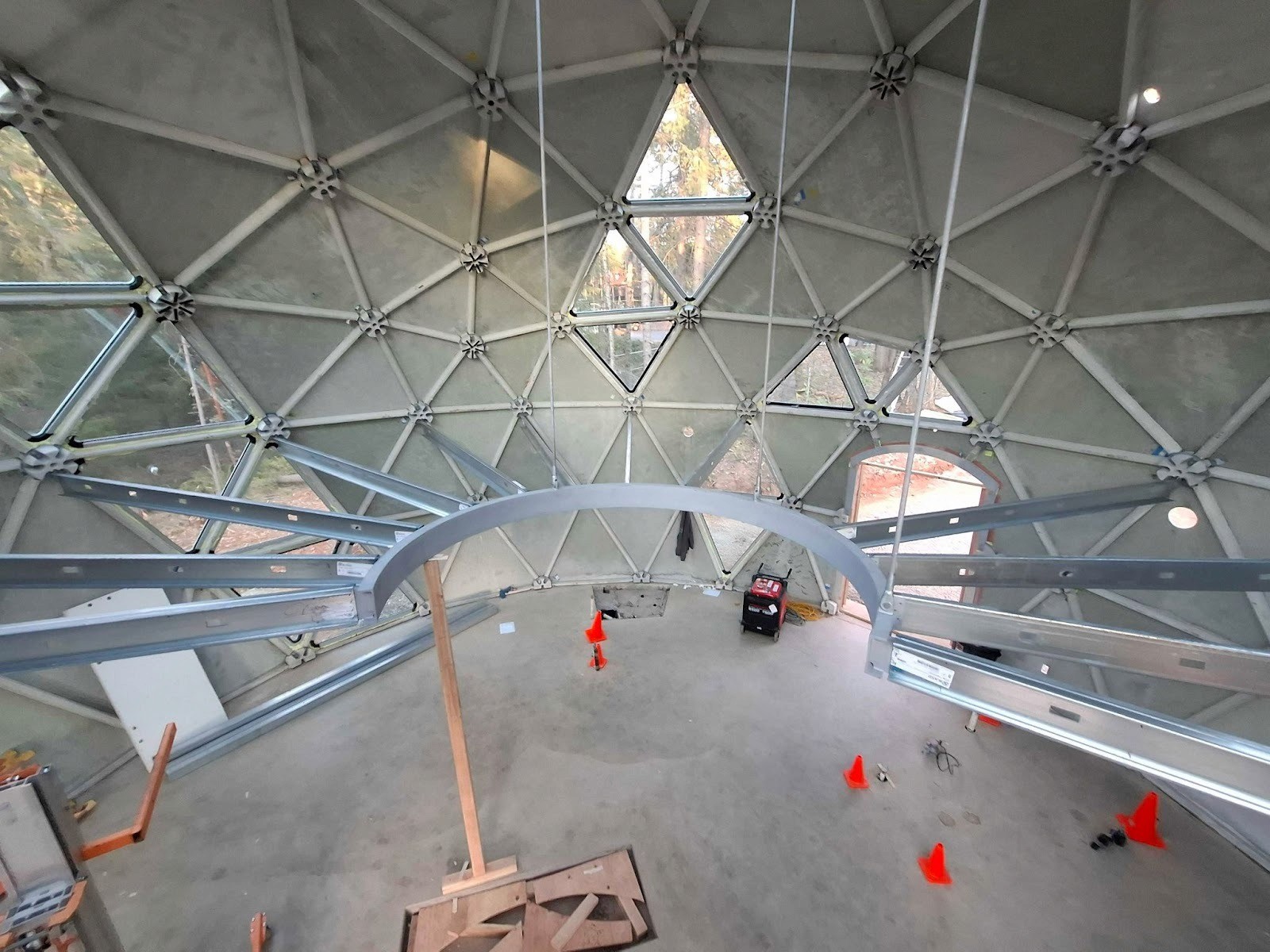
The process begins with the center ring, a circular structural element suspended from the dome's interior and leveled precisely using threaded rods tied to the ceiling. Once the ring is secure and level, joists radiate outward from it in a pie shape, connecting at the outer edge to knife plates welded into the second-row hubs during frame assembly.
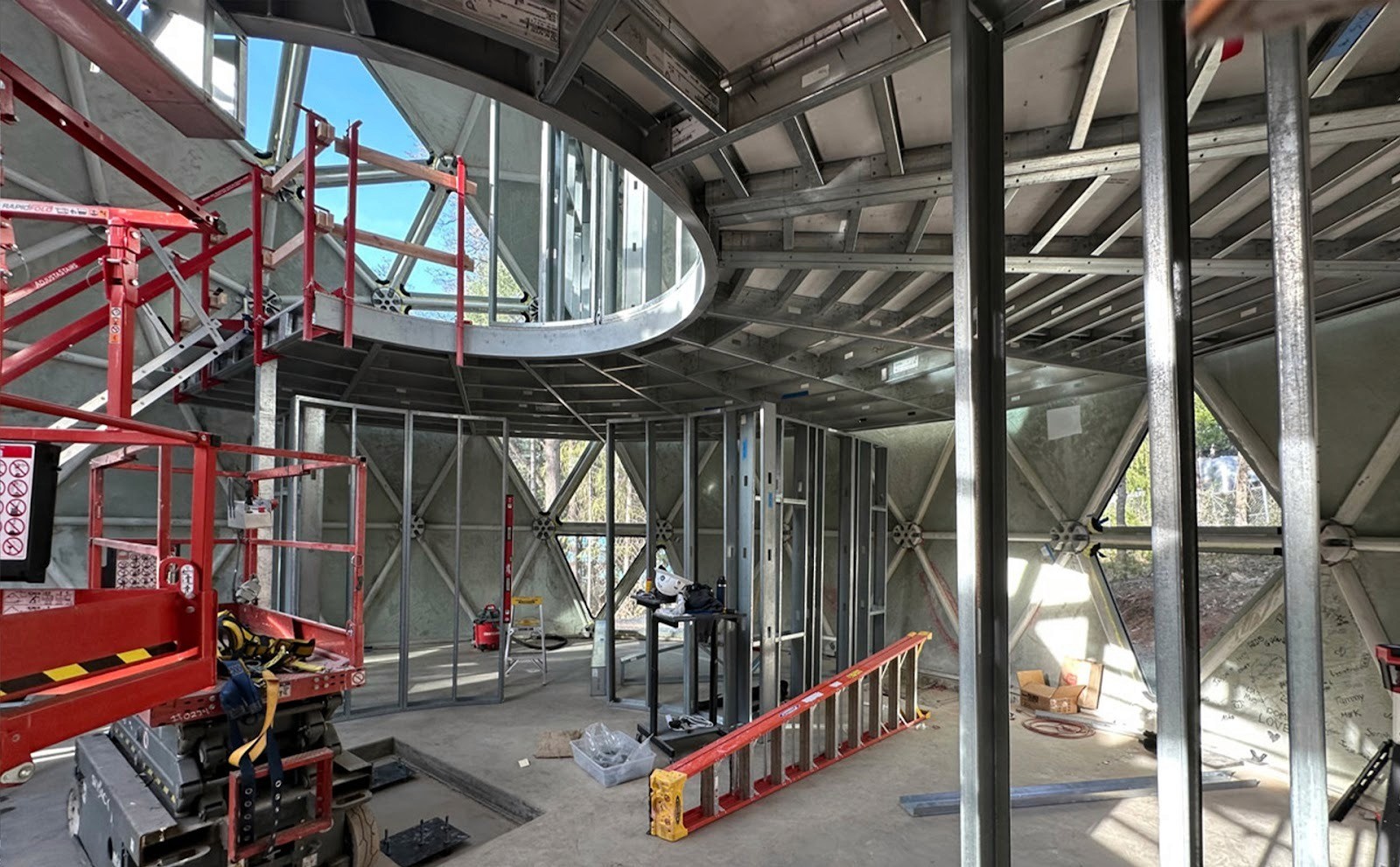
Once the purlins are in place, MGO (magnesium oxide) board panels are laid on top to create the loft subfloor. The result is a rigid, level platform ready to receive interior finishes, all assembled from components that arrived on site with exact specifications and no cutting or measuring required.
Inside the Geoship Pilot Factory
The site work in Nevada City tells one side of the story. The other side happens 10 minutes away, inside the Geoship Pilot Factory. Andrew James, VP of Engineering and former Tesla Model 3 interior engineer, opens the doors for an inside look at the production line that feeds every component to the Amma One build.
Raw Material Receiving and Batching
Production begins at the receiving area, where raw materials are organized onto shelving that holds just over one dome's worth of inventory. From there, materials move to the dry handling line, where they're precisely measured according to the batch recipe and sorted into color-coded buckets. Each bucket holds a specific ingredient, staged and ready to move to the mixing system.
Mixing
The mixing system is where things get proprietary. Because GeoRock bioceramic material has properties unlike conventional building materials, no off-the-shelf mixing equipment could meet its requirements. Geoship designed and built a custom system from scratch. Dry materials are fed in first, followed by liquid ingredients. Due to the proprietary nature of the machine, the specifics stay behind closed doors, but the output is a precisely mixed bioceramic material ready to be dispensed into molds.
Curing and Demolding
Filled molds move into the curing line, and here is where the material science gets remarkable. Unlike concrete, which requires days of water curing, and unlike traditional ceramics, which require high-temperature kilns, GeoRock generates its own heat during curing, reaching approximately 140°F through an exothermic reaction. By the time a mold reaches the end of the line, the part is ready to demold.
"It's that rapid curing and its ability to generate its own heat that really enables us to scale this product and platform." - Andrew James
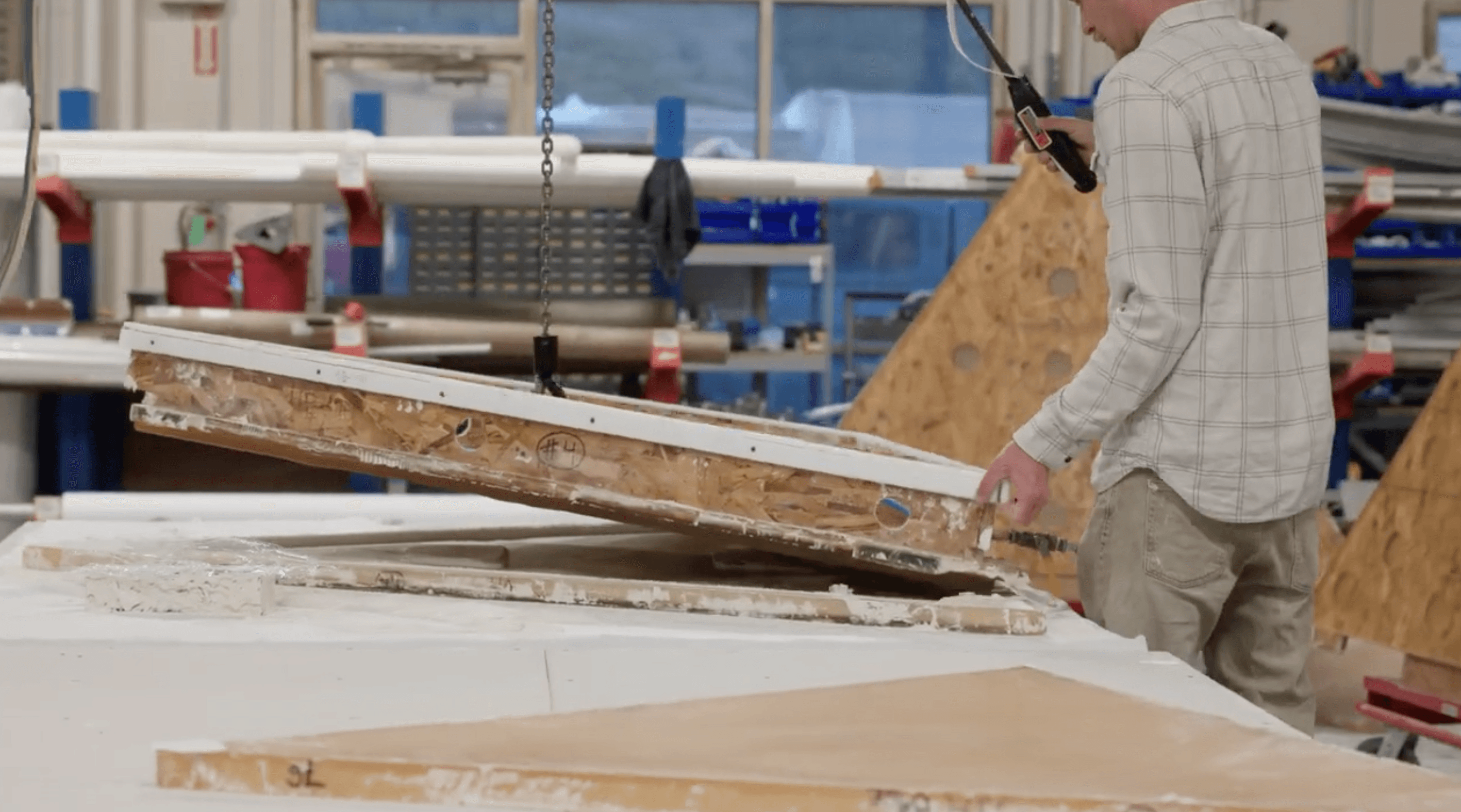
The manufacturing process is formative, meaning the material is shaped by the mold rather than cut from a larger piece. This eliminates the waste generated by traditional construction's cutting and material removal processes. Every bit of material goes exactly where it's needed.
After demolding, the mold is cleaned and sent back through the line for another cycle. This closed-loop conveyance system is what makes continuous iteration possible.
The Mold Loft
Tucked in a corner of the factory is the mold loft, where the team designs, builds, and refines molding techniques. Both the materials used to construct molds and the construction methods themselves are under constant development. This rapid iteration capability has allowed the team to tune mold performance to the exact requirements of the Amma product line.
Material Science Lab
Behind a separate set of doors, Geoship's material scientists run daily experiments to refine and improve the bioceramic formulations. They don't work in isolation. Scientists are regularly out on the factory floor, working alongside the production team to tune processes in real time.
Quality Control, Subassembly, and Shipping
Every part that comes off the line passes through a quality control station where it's inspected against product requirements. Parts that pass QC move to inventory staging until they're ready for shipment.
But the factory doesn't just produce individual components. It also builds subassemblies: door frames, wall frames, plumbing assemblies, electrical assemblies, and more. Consolidating this work under one roof, rather than distributing it across multiple field crews, ensures higher accuracy and quality while speeding up the on-site installation process.
"Rather than having this labor in the field and running different instructions and different crews in the field, we can consolidate all of that work under one roof and assure really high-accuracy and high-quality results." - Andrew James
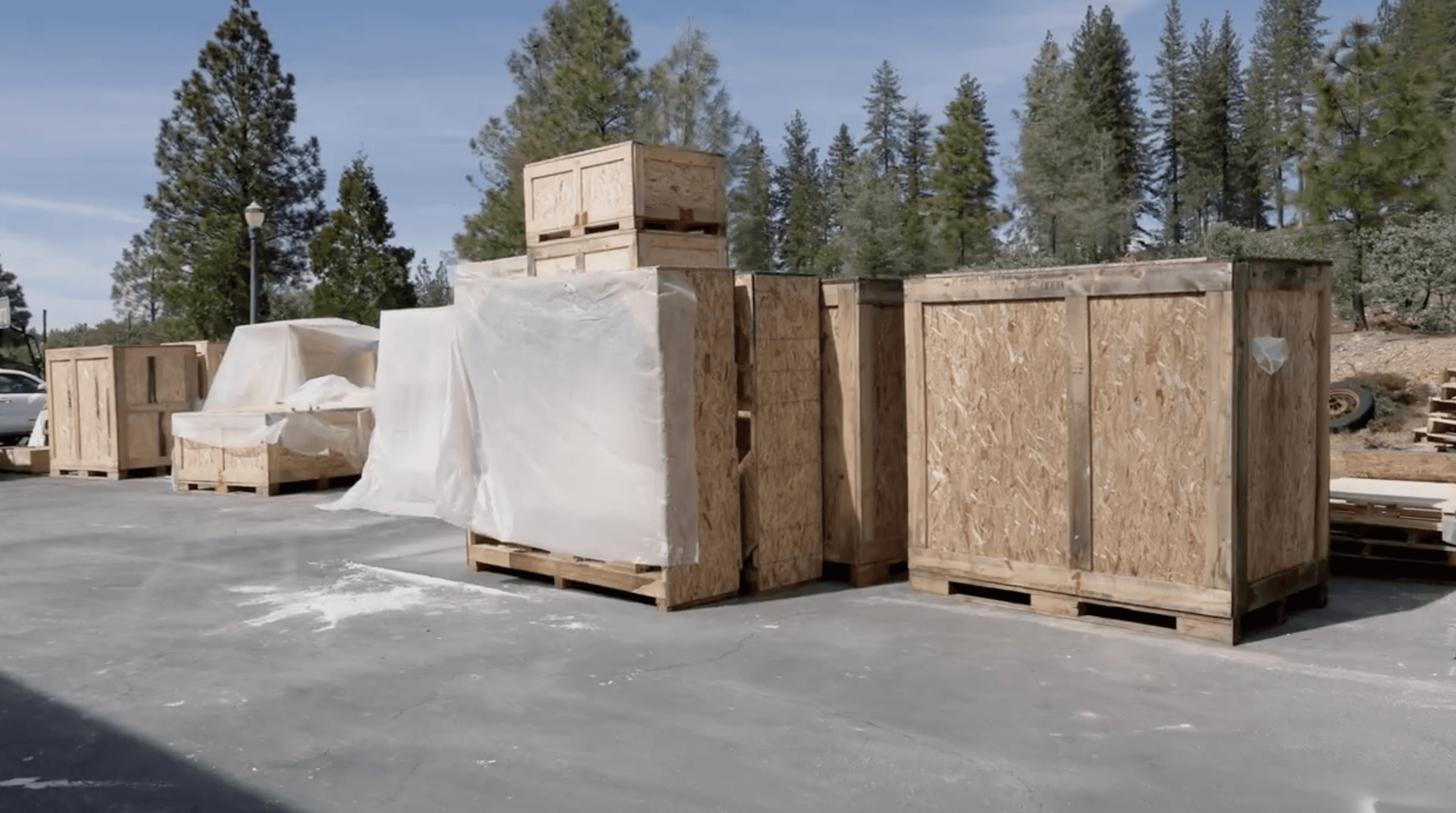
When everything is complete, parts and assemblies are packed into crates and shipped to site, where they're unpacked and assembled into the dome. No framing piles. No chaotic build site. Precision assembly of an engineered system.
From Pilot Line to Platform
It's worth pausing on something Andrew emphasizes during the tour: the molds currently in production were designed specifically for Amma One, but the manufacturing system itself is product-independent. Geoship is developing core manufacturing technology, the mixing, curing, conveyance, and quality systems, that scales well beyond any single dome model.
This is the difference between building a house and building a housing platform. Every iteration on the pilot line, every refinement to the curing process, every improvement to a mold, feeds forward into the production system that will manufacture the next model and the one after that.
The exterior shell is sealed. The loft floor is going in. And the factory that will produce hundreds and eventually thousands of domes is being refined in real time. Amma One is not just the first home. It's the proof of concept for everything that follows.
Thank you for following this journey and believing that housing can be built differently. Whether you're an investor, a future homeowner, or someone who shares the vision of regenerative living, you're part of making this transformation possible.
-The Geoship Crew